International Women's Day: Meet Sephora Mandombo, a 19-year-old student who decided to become a teacher to finance her university studies.
According to a recent survey by the United Nations Educational, Scientific and Cultural Organization (UNESCO), women account for less than 30% of primary school teachers in the DRC and only 11% of secondary school teachers.
Added to this is the fact that, until recently, this subsector was considered less attractive, particularly given the working conditions of staff, which were very precarious until two years ago. It is no surprise that nearly 20% of staff in the primary, secondary, and technical education (EPST) subsector are over 50 years old.
In this month dedicated in particular to women’s empowerment, we met with a teacher to discuss her motivations for working in education at such a young age, when several other options—and not the least of them—could have been available to her.
In an interview with the editorial team of the EPST Communication Management Directorate (DGC-EPST) on Wednesday, March 8, 2023, Sephora Mandambo, 19, recounts how she managed to finance her university studies after convincing her parents to let her pursue her dream by embracing this profession at such a young age.
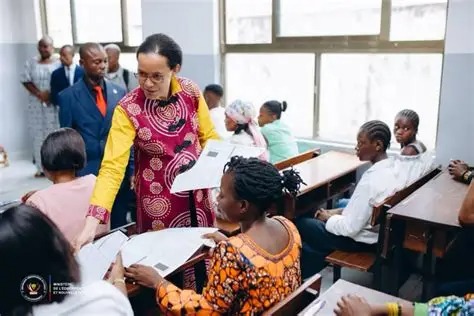
Sephora, the eldest of five children, has been teaching second grade at La Bannière School in Kinshasa since 2019. The school is located in the Barumbu commune, Esanja neighborhood, on Kapinga Avenue.
Fascinated by this profession from a young age, it was at the very school where she was educated that Sephora decided to teach the younger students herself.
“I’ve harbored this desire to be like my teachers since I was very young. And having the opportunity to be hired at the very same school that watched me grow up was, in itself, a source of even greater pride… It’s true that at first, my family was a bit hesitant given the reputation of this profession compared to others in the DRC. Teachers, just like police officers, are seen as the lowest of the low among government employees… The various reforms announced at the time as part of the push for free education notably influenced my family’s decision. They eventually came around,” she told us.
Sephora doesn’t deny that this profession pays better today than it did five years ago, even though, she notes, there are still hurdles to overcome in improving the living conditions of Congolese teachers.
“Perhaps if I had to teach five years ago, I might have thought twice before committing. But today, the salary I earn at least allows me not to depend on my parents or expect everything from a fiancé or older brother. It’s far from ideal, but it’s enough for me already; I can finance my university studies with it,” she continues.
Sephora intends to pursue a career in teaching.
“I started very young; it’s true that any promotion in the future will encourage me even more. That’s why we work, isn’t it! I’m thinking of being promoted to the teaching council, for example, or becoming an inspector or a school principal…,” she says.
There is no shortage of challenges in the professional world. Sephora has not been spared them either in her young career as an elementary school teacher.
She mentions, among other things, the basic education of certain students whom she describes as “problem children.”
“A child’s development doesn’t happen solely at school; it’s essential for parents and the school to communicate regularly about classroom work, the student’s learning achievements, and their progress, and then to share educational support strategies. Additionally, student absences exacerbate this difficulty, because it’s absolutely necessary to review material so that all students are at the same level in their subjects.”
The young student believes that the current education system must be improved by strengthening teaching and educational resources. She also mentions the implementation of digital advancements, which must be accessible at all levels.
Cynthia Kanama